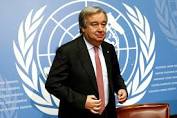
The new United Nations Secretary – General, Antonio Guterres, resumes office today. In his speech, he promises to be a “bridge-builder”.
Guterres, a former Portuguese prime minister and U.N. refugee chief told reporters after being sworn-in as secretary-general on Dec. 12 that he will engage all governments “and, of course, also with the next government of the United States” and show his willingness to cooperate on “the enormous challenges that we’ll be facing together.”
As Guterres begins his five-year term facing global conflicts from Syria and Yemen to South Sudan and Libya and plus terrorism and climate change challenges, the U.S. one of the UN Security Council veto-wielding member’s support for the United Nations remains a question mark.
The US’ support matters because it pays 22 percent of the U.N.’s regular budget and 25 percent of its peacekeeping budget.
The former US ambassador to the United Nations and a conservative Republican, John Bolton, said in an interview with The Associated press that Guterres would be well advised “especially given the incoming Trump administration” to follow the model of his predecessor, Ban Ki-moon, and do what member governments want, News now reports.
If he tries to follow what Ban’s predecessor, Koffi Annan, did as secretary-general and try to be the world’s top diplomat and what some called “a secular pope,” Bolton said, “I think especially in the Trump administration, he would run into big trouble very quickly.”
Guterres has made clear that his top priority will be preventing crises and promoting peace.
In the first minute after taking over as U.N. chief on Sunday, Guterres issued an “Appeal for Peace.” He urged all people in the world to make a shared New Year’s resolution: “Let us resolve to put peace first.”
“Let us make 2017 a year in which we all — citizens, governments, leaders — strive to overcome our differences,” he added.
He further called for “the diplomacy for peace,” which he plans to focus on considering the enormous difficulty in solving conflicts.
Guterres added that he will also strive to deal with the inequalities that globalization and technological progress have helped deepen, creating joblessness and despair especially among youth. “Today’s paradox is that despite greater connectivity, societies are becoming more fragmented. More and more people live within their own bubbles, unable to appreciate their links with the whole human family,” he said after his swearing-in.
Guterres said the values enshrined in the U.N. Charter that should define the world that today’s children inherit — peace, justice, respect, human rights, tolerance and solidarity — are threatened, “most often by fear.”
“Our duty to the peoples we serve is to work together to move from fear of each other, to trust in each other, trust in the values that bind us, and trust in the institutions that serve and protect us,” he said. “My contribution to the United Nations will be aimed at inspiring that trust.”
Whether the Trump administration will join Guterres and U.N. efforts to tackle what he sees as “a multiplication of new conflicts” and the myriad problems on the global agenda remains to be seen, News Now reports.
Guterres also aims at reforming the United Nations to make it “nimble, efficient and effective.” According to him, “it must focus more on delivery and less on process, more on people and less on bureaucracy,” and ensure that the more than 85,000 U.N. staff working in 180 countries are being used effectively.


Leave a Reply